MAE and MFE:
heat and run.
How far a trade went against you, and how far it went your way, while you were in it. Journalcade calls them Max Heat and Max Run.
MAE, the maximum adverse excursion, is the worst a trade got before you got out. MFE, the maximum favourable excursion, is the best open profit it showed. Compared with your stop and your exit, they show whether your stops are too tight and how much of each move you kept.
Long NQ at 21,000 with a 10-point stop. It dips to 20,994 (6 points of heat, 0.6R), runs to 21,030 (30 points, 3R) and you exit at 21,020. You kept 20 of the 30 points the trade showed: 67%.
Runs in your browser: nothing you type is sent anywhere. Arithmetic, not advice.
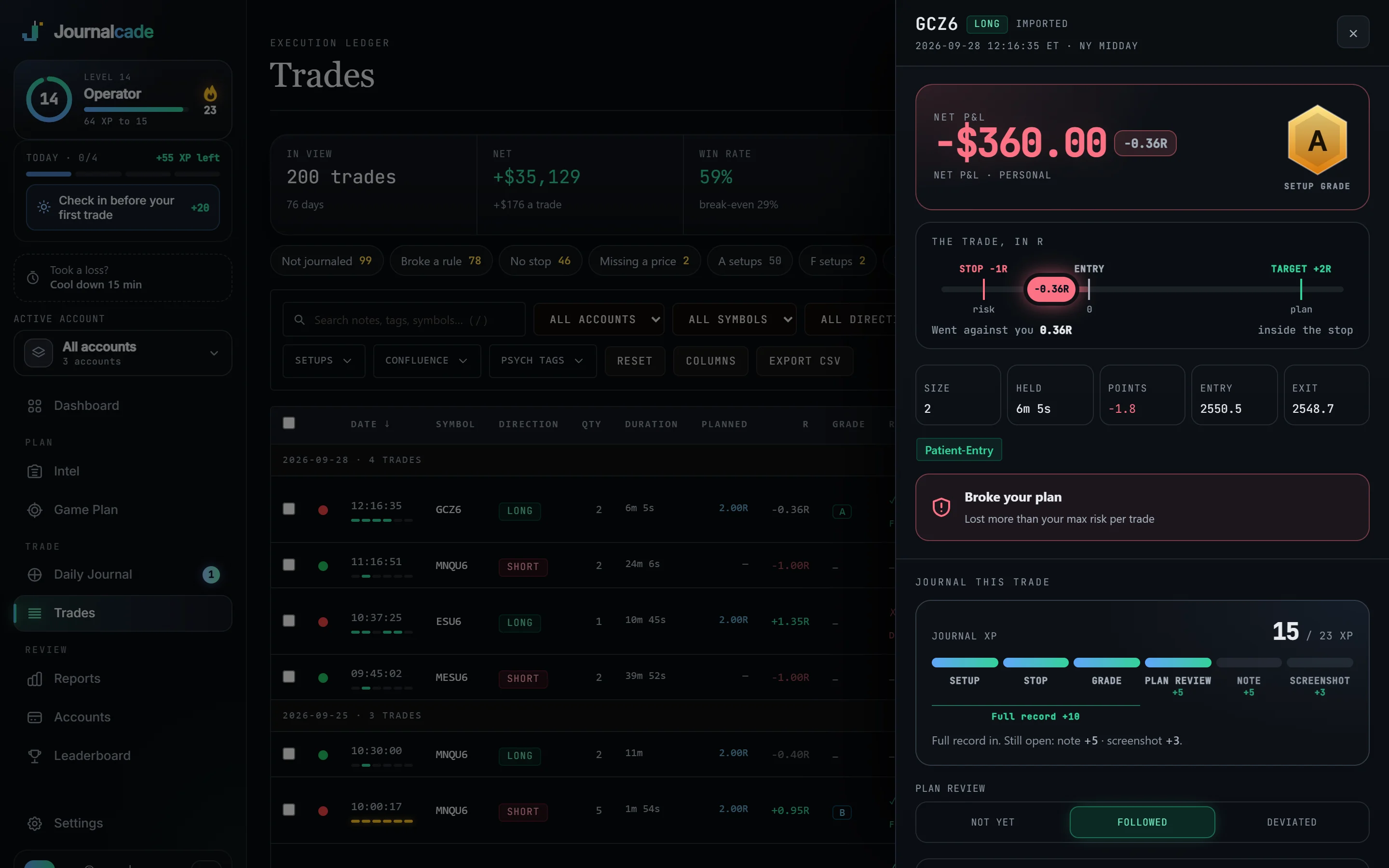
Heat and run, on every trade you review.
Log Max Heat and Max Run when you review a trade, and the full run after the session. Journalcade shows what each trade left on the table and the target that would have paid most per setup.
- Max Heat and Max Run in points and R
- What each trade left on the table
- The best target per setup, from your trades
Quick answers.
What is the difference between MFE and the full run?+
What does a small MAE on winners tell me?+
Where do I find these numbers?+
Do I need them for every trade?+
Your Rookie card is waiting.
Free to start. Journal your first trade today and watch the numbers fill in.